The Cabinet of Curiosities and the Pleasure of Bringing Things Together
The cabinet of curiosities shows how collecting turns unlike objects into a conversation, helping you choose a personal group with more meaning.
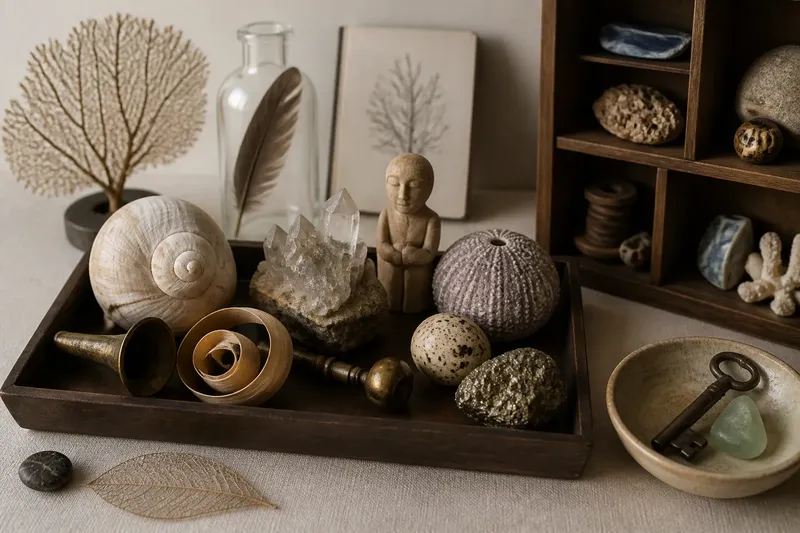
What makes a group of unrelated objects feel like a collection rather than a pile? The cabinet of curiosities offers a useful answer: the collector’s choices invite one object to change how you see another. A shell beside a mineral, a small tool beside a carved figure, can make a quiet comparison without insisting that everything belong to the same category.
These compact rooms and cabinets brought together natural specimens, crafted objects, souvenirs, and items that resisted easy classification. Their appeal was not simply that they held many things. They arranged difference so a visitor could look, compare, wonder, and make connections. That idea still helps an amateur collector decide what belongs together—and what a personal collection is for.
Difference creates conversation
A conventional collection often gathers objects by type: shells with shells, stamps with stamps, teacups with teacups. A cabinet of curiosities could loosen that rule. Its objects might sit together because they shared a striking shape, an unusual texture, a story of travel, or the collector’s interest in how nature and human craft resemble each other.
Imagine you have a pale spiral shell, a curled shaving from a carpenter’s plane, and a small brass horn. They do not form a neat taxonomic set. Yet their curves offer a visual link; their different materials make that link more noticeable. The expected result is not a formal classification but a group that encourages someone to look from one curve to the next.
This kind of arrangement depends on contrast as much as resemblance. A dark stone may make a bright feather seem lighter. A finely worked object can draw attention to the irregular edge of a natural specimen. The objects are not interchangeable; their differences are the reason the pairing works.
When choosing companions, ask what the second object makes you notice in the first.
Selection is the collector’s voice
Bringing things together is an act of editing. A collector does not need to claim that a group is complete or universally important. The selection can express a narrow curiosity: things with holes, objects that fit in a coat pocket, found pieces with faded blue surfaces, or small items shaped by a turning motion.
A useful theme is specific enough to guide a decision but roomy enough to allow surprise. “Interesting things” rarely helps you choose what to keep. “Objects that show how a curve is made” gives you a question to carry into a walk, shop, or drawer, while leaving space for a shell, a bent wire, or a carved wooden handle.
Try writing a short collecting sentence before you add more objects. For instance: “I keep small things whose marks reveal how they were made.” That sentence can help you decline an attractive object that does not deepen the collection, and welcome an unexpected one that does.
A collecting sentence should guide you, not turn into a rule you are afraid to revise.
What makes an arrangement work?
How do I choose a theme?
Start with a comparison you already enjoy making, such as smooth against rough or natural form against manufactured form. Keep the theme open enough that you can discover objects beyond one familiar category.
Do the objects need to be rare?
No. An ordinary button, leaf skeleton, or worn key can be compelling when its details matter to the question your collection asks. Rarity may attract attention, but it cannot supply the connection between objects for you.
How can I arrange unlike objects?
Begin with one relationship you want a viewer to notice: shared color, repeated curve, difference in scale, or a contrast in material. Leave a little visual space around the objects, then change their positions until the relationship reads without a long explanation.
Should every object stay in the collection?
No; a collection can change as your curiosity sharpens. If an object no longer helps express the group’s question, you can move it elsewhere, return it to its source when appropriate, or let it go responsibly.
Small displays, clear choices
A cabinet need not be a literal piece of furniture. A shallow tray, a shelf, a box with compartments, or a cloth laid on a table can create a temporary display. The important choice is which objects you place in view and what their arrangement lets you compare.
Use simple supports that suit the objects: a folded card can raise a small flat item, while a plain dish can keep loose pieces from wandering. Avoid forcing a fragile or borrowed object into a pose. If an item’s material or condition makes handling uncertain, follow its maker’s or owner’s guidance rather than improvising a display.
Consider height and spacing as part of the selection. A row can make differences easy to compare; a cluster can suggest a shared center of interest. One object placed apart may act as a pause, or signal that it complicates the pattern. These choices are modest, but they change the pace of looking.
For a quick trial, select only a few pieces and arrange them on a sheet of paper. Move one object at a time, then notice which relationship becomes easier to see.
Labels without a lecture
Labels can add context, but they do not have to settle every question. A short note might name where an object came from, what material it appears to be, or why you paired it with its neighbor. Mark uncertainty plainly: “possibly bone” is more honest and useful than a confident guess.
Try a label that points toward comparison: “Both surfaces carry a spiral, but one grew and the other was cut.” That kind of sentence gives a visitor a place to begin looking. It does not dictate what the objects must mean.
If the collection is just for you, labels can be working notes. Write on removable cards rather than on an object, especially when its surface or ownership makes marking inappropriate. A note can record your changing thought: what first caught your eye, and what the pairing now reveals.
Keeping the group alive
Collections can become stale when every new object is judged only by whether it resembles what is already there. A cabinet of curiosities suggests another test: does this object create a fresh comparison? A smooth pebble may belong beside a polished bead because they catch light differently, not because they share an origin.
Every so often, take the objects out and arrange them around a different question. You might shift from “What are these made of?” to “What has touched or changed their surfaces?” The same group can then disclose a different set of details, and the collection can develop without constant acquisition.
That practice also makes selection tangible. Keep a small “not now” box for objects you are unsure about, and revisit it when you rearrange the display. If a piece still feels disconnected, it may be a fine object that belongs to another interest rather than this collection.
The cabinet of curiosities remains a helpful model for collecting because it treats arrangement as thought, not decoration. A personal collection gains character when its objects make one another more noticeable and when the collector is willing to choose, revise, and leave room for a surprise. The next time you bring something home, set it beside an object you already own before deciding where it belongs; that small comparison may tell you more than the object alone.