The Myth That Every Sketch Must Become a Finished Picture
An unfinished sketchbook can hold useful questions, observations, and experiments. Choose what to develop—and what to leave as a working note.
Does every sketch in your sketchbook need to become a finished picture? No. A sketchbook can hold careful observations, open questions, and experiments that have done their job without turning into polished work. The useful choice is not “finish everything or give up,” but “what does this page need to do?”
That answer changes with your situation. You might be trying to understand a bird’s posture, untangle a tricky perspective, or keep a fleeting arrangement of light from slipping away. Some pages invite a second pass. Others are better left as evidence of a moment of looking. Treating every page as a potential artwork can make the book feel like a queue of obligations rather than a place to think.
When you are observing
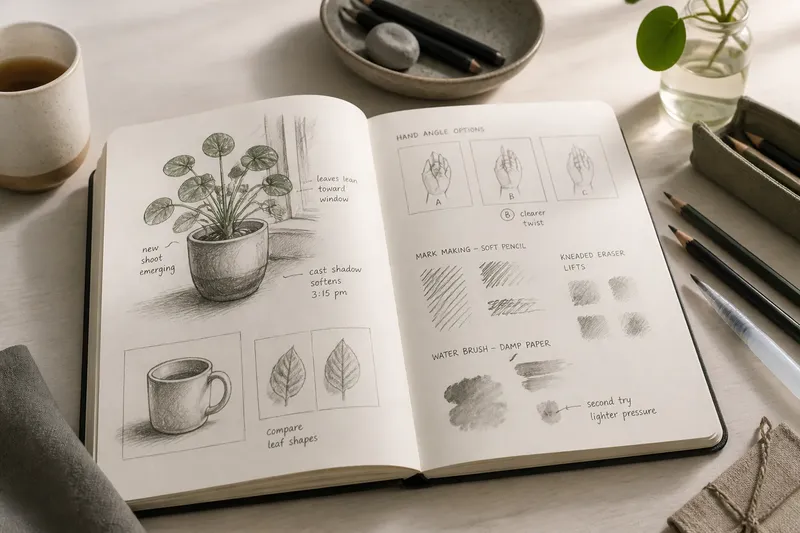
If you draw to notice what is in front of you, an unfinished study often fits best. A quick drawing of a houseplant can record which leaves lean toward the window, where a new shoot emerges, or how the pot’s rim changes shape from your seat. Those notes may matter more than smooth shading.
Give the page a small purpose before you begin: track the curve of the stem, compare leaf shapes, or mark where the cast shadow falls. A few arrows or words can clarify what the drawing alone leaves uncertain. You are making a record of attention, not a display piece.
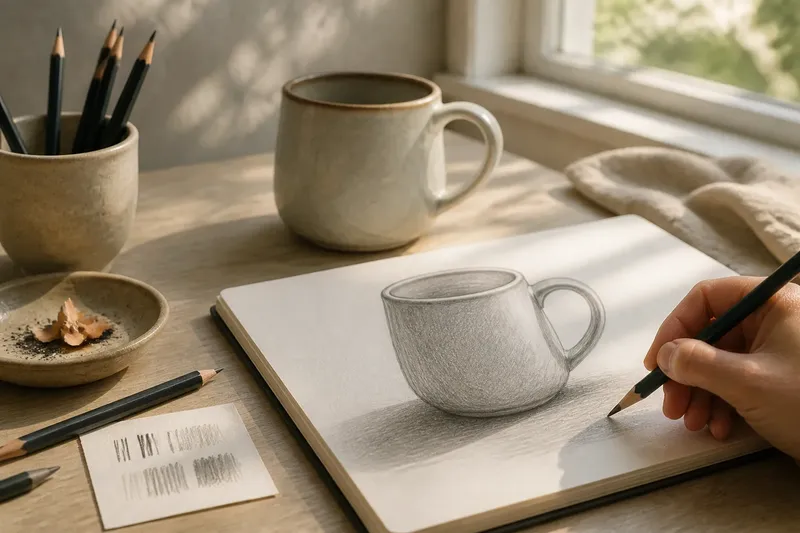
Say you sit by a kitchen window and sketch a ceramic mug as afternoon light moves across it. You focus on the oval rim and add a small note that the shadow has softened. When the light shifts, you stop; the page has captured the question you were watching, even though the mug has no finished background.
For observational practice, leave the drawing open when the subject or light changes before you have a reason to continue.
When you are solving a problem
If one part of a picture keeps resisting you, use the sketchbook to make alternatives rather than polish a single answer too soon. Small studies can compare the angle of a hand, the curve of a bowl, or the placement of a figure in a doorway. Their value lies in making choices visible.
Keep each attempt simple. Try a few different contours in separate boxes, or draw the same object from a slightly altered viewpoint. Circle the version that communicates the shape most clearly and jot down what helped. A rough comparison can answer a practical question faster than rendering every option.
This approach suits artists who feel stuck because they have mistaken uncertainty for a flaw. An awkward study can show precisely where your understanding breaks down: perhaps the near edge looks too long, or the figure’s weight seems to fall in the wrong direction. That diagnosis gives your next session somewhere to begin.
When you are comparing possibilities, keep the alternatives small enough that each one tests a distinct choice.
When you are learning a tool
If you are getting familiar with charcoal, colored pencil, a brush pen, or a new kind of paper, unfinished pages are useful test ground. A page may be devoted to how a mark changes under pressure, how two colors overlap, or how a kneaded eraser lifts graphite. The point is to notice what the material does, not to disguise every trial as a composition.
Write the material beside the mark when you might forget it: “soft pencil, side of lead” or “water brush, damp paper.” Keep one area for first attempts and another for a second try with a deliberate change. This makes the page a record you can return to when you want a similar effect.
Choose a test that answers one question at a time. If you change the paper, pressure, and drawing tool together, it may be hard to tell which change shaped the result. You do not need a formal chart; a few labeled swatches or simple shapes can be enough.
For material experiments, leave the marks visible so the page remains useful as a reference.
When you want a finished piece
Sometimes a sketch keeps drawing you back. You may like its composition, want to share the idea, or see a clear path toward a more resolved image. That is a good reason to develop it—but not proof that every page deserves the same treatment.
Before continuing, name what you want from the next version. Perhaps you want stronger contrast, a clearer focal point, or a larger format that gives the subject room. If you cannot name a change, the sketch may already have served its purpose. You can still enjoy it as it is.
A sketchbook can also contain both working pages and finished drawings. If you like, mark a few pages for longer work with a tab or a small symbol in the corner. Let the rest remain available for notes and trials. This keeps the decision local: one promising page can grow without turning the whole book into a promise to finish.
Develop a sketch when you can point to a specific quality you want to preserve or improve.
When a page feels incomplete?
How do I know when a sketch is done?
Ask whether it answered the question you brought to it or recorded the detail you wanted to remember. If it did, stopping is a reasonable choice, even if the page still looks rough.
Should I erase drawings I dislike?
Usually, you can leave them and add a note about what feels off. Keeping the attempt makes it easier to notice what you would change next time, while erasing it removes that useful context.
What if I want to share an unfinished study?
Share it as a study and say what you were looking at or trying. A brief caption helps viewers understand that the page is an observation or experiment, not a polished picture presented as complete.
Can I return to an old sketch later?
Yes, if a fresh question occurs to you. Add a date or a short note beside the new work so the page shows both the original observation and what you learned on returning to it.
When you want to share
If the sketchbook is for private use, you do not need to prepare every page for an audience. If you share it with friends or in a class, choose pages that show the kind of looking or learning you want to discuss. A rough study may invite a more useful conversation than a polished picture, especially when you point out the question behind it.
You can also make the page legible without making it finished. Add a date, name the subject, or draw a small arrow to the detail that matters. Those modest clues help you—and anyone you invite to look—understand the page’s purpose later.
For a shared sketchbook, offer context rather than an apology. “I was checking the angle of the roof” tells a reader what the drawing is doing. “Sorry, this is bad” turns attention away from the observation and toward judging the page by a standard it was never meant to meet.
Choosing what stays open
When you look back through your book, sort pages by what they helped you do: observe, compare, test, remember, or develop an image. You might add a small mark in the margin or simply notice the pattern as you turn the pages. There is no need to grade them or rank them by polish.
If a page still raises a question, write it down rather than forcing an answer immediately. “What happens if the branch overlaps the roof?” is a useful prompt for another drawing session. If the page has no remaining work for you, leave it alone.
The myth that every sketch must become a finished picture makes a sketchbook feel like a collection of unfinished promises. A better measure is whether a page helped you see, think, or try something. Keep the sketchbook open to that work, and let finished pictures emerge when a particular idea calls for them.